
Fit puzzle Games Games
3 Games Available
Enjoy free fit puzzle games where you drag, rotate, and place shapes into the perfect position. Test your logic, spatial reasoning, and problem-solving skills online.
You Might Also Like
Top-rated trending games across Khelogy


About Fit puzzle Games
Genre overview, tips & gameplay guide
Fit puzzle games look simple — pieces on one side, spaces on the other. The challenge is that the brain has to rotate shapes mentally, compare them against available gaps, and predict how each placement affects the moves that follow. All of that happens before a single piece is placed.
Khelogy has free fit puzzle games covering block fit formats, shape fitting puzzles, object silhouette games, and packing puzzles. No download. No account. The first piece is already on screen.
What the Brain Does When Fitting Shapes Together
It is not just guessing. Several things happen at once.
When a player picks up a puzzle piece and evaluates where it goes, the brain is simultaneously rotating the shape mentally, comparing it against available spaces, recalling which spaces are still open, and predicting how placing this piece affects future moves. A 2025 study published in PLOS ONE examining cognitive strategies in jigsaw-style fitting tasks found that players consistently used both mental rotation and physical constraint reasoning — considering not just whether a piece matches a space but how the two objects interlock under real geometric pressure.
That combination — rotation plus constraint reasoning — is why fit puzzles are cognitively demanding despite looking simple. The shapes are visible. The spaces are visible. The solution is still not obvious.
Block Fit Puzzle Games — Grid Meets Shape
Place the block. Align the markers. Clear the row.
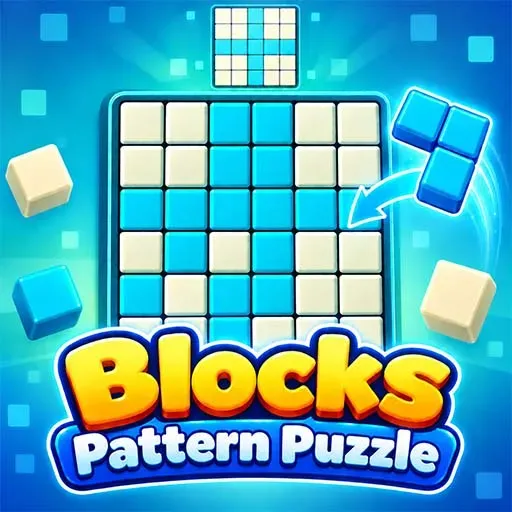
Block fit puzzle games use a grid as the playing field. Oddly shaped blocks arrive in sets and the player drags each one onto the grid to fill rows, columns, or specific marked positions. When a complete row or column is formed it clears, creating space for what comes next. When no more pieces can be placed the game ends.
Tetris established this format in 1984. It has never stopped being played. The block fitting mechanic — placing irregular shapes into a shared grid space — remains one of the most studied game formats in cognitive research precisely because it forces genuine spatial problem-solving on every single move. A piece that fits the available space now might block the next three pieces. That forward planning separates casual players from high scorers.
What is a block fit puzzle game?
A game where irregularly shaped blocks must be placed onto a grid to fill rows or align with marked positions. Completed rows clear to make room for more. The challenge is fitting current pieces without blocking future placements — which requires planning several moves ahead rather than placing each piece reactively.
Free Fit Puzzle Games on Khelogy
All free. No payment. Open Khelogy, pick a fit puzzle game, start placing.
- Block fit puzzle games — grid-based placement, rows clear when complete, plan ahead or run out of space
- Shape fitting puzzle games — irregular outlines, drag pieces into position, every piece must fit perfectly
- Object fitting puzzle games — real-world shapes and objects fitted into silhouettes, observation and rotation required
- Packing puzzle games — fill a defined space completely using a specific set of pieces, no gaps allowed
Shape Fitting Puzzle Games — No Grid, Just the Outline
The space has a specific shape. The pieces have specific shapes. Make them all fit.
Shape fitting puzzle games remove the grid entirely. The playing field is an irregular outline — a silhouette, a defined boundary, a specific closed shape. A set of pieces must fill it completely with no gaps and no overlap. The pieces are fixed in number. The space is fixed in size. The solution exists. Finding it requires rotating pieces, trying combinations, and building a mental model of which piece fills which portion of the outline before committing to a placement.
This format is ancient. Tangrams — seven geometric pieces that form hundreds of different silhouettes — have existed in Chinese puzzle culture for centuries. The digital version adds undo buttons, hint systems, and hundreds of unique levels that physical tangrams cannot provide. The spatial challenge is identical.
Packing Puzzles — Every Gap Is a Failure
The goal is zero empty space. That is harder than it sounds.
Packing fit puzzle games present a container and a specific set of pieces. Every piece must fit inside the container. No leftover pieces. No empty space remaining. The pieces are designed to fit together perfectly — but only in one arrangement, or a very small number of arrangements. Finding that arrangement requires testing combinations and building a sense for which pieces logically occupy which regions.
Stanford's DREME research initiative found that children who regularly engaged with shape-based puzzle play developed significantly better spatial transformation skills — the ability to mentally picture what a shape looks like after rotation or flipping. That skill transfers directly into mathematics, engineering thinking, and any spatial task requiring visualization of objects in space.
Are fit puzzle games good for children?
Research published by the Association for Psychological Science found that children who played with puzzles and blocks frequently scored higher on spatial reasoning assessments. Fit puzzle games build the same skills — mental rotation, spatial awareness, shape recognition — through digital play that requires no physical materials.
Drag and Drop vs Rotation-Based Fitting
Two mechanics. Different cognitive demands.
Drag and drop fit puzzle games let the player pick a piece and move it freely across the board. The piece snaps into position if placed correctly. The challenge is recognizing where it belongs from a visual scan of available spaces.
Rotation-based fitting games add an extra step. The piece must be rotated to the correct orientation before it can be placed. The player cannot just find the right location — they have to find the right location at the right angle simultaneously. This doubles the search space the brain has to evaluate and is why rotation-based fitting puzzles feel more challenging than simple drag-and-drop formats even at the same piece count.
No Download. Opens in the Browser.
Browser opens. Pieces appear. The first space is waiting.
No app. No installer. Works on Chrome, Firefox, Safari. Fit puzzle games are lightweight by design — clean interfaces, simple graphics, fast load on any device. Phone and tablet work naturally — dragging and rotating pieces with a finger is more intuitive than using a mouse for most fitting formats.
Why Khelogy
No account. No download. Nothing between the player and the first piece.
Open Khelogy. Pick a fit puzzle game. Find where it goes.
Over 1,000 free games. Loads in any browser. Works on phone, tablet, and desktop. New games added regularly.
One piece at a time.
Frequently Asked Questions
Got questions about Fit puzzle Games games? Find quick answers below.
Puzzle games where the player places, arranges, or fits shapes and blocks into specific spaces or outlines. Formats include grid-based block fitting, silhouette shape fitting, packing puzzles, and object placement challenges.
All free. No payment. No account. Pick one and start fitting.
Nothing. The game opens directly in the browser. Click play and the pieces appear immediately on any device.
Research published in Psychological Science found that regular puzzle and block play is directly linked to stronger spatial reasoning scores. Fit puzzle games train mental rotation, shape recognition, and forward planning — skills that transfer well beyond the game itself.
Simple shape fitting with large pieces suits children from around age four or five. Block grid fitting and rotation-based puzzles suit older children and adults. Most fit puzzle game collections include both beginner and advanced difficulty levels.
Android and iPhone both work. Dragging and rotating pieces with a finger is more natural on touchscreen than using a mouse. Open the phone browser, go to Khelogy, no app needed.
Jigsaw puzzles assemble a single image from many pieces — the picture guides placement. Fit puzzle games use abstract shapes, blocks, or silhouettes where the geometry is the only guide. No image to follow. Pure spatial reasoning required.