



.webp)
.webp)
.webp)
About IQ Puzzle Games
IQ puzzle games are built around one idea — the obvious answer is usually wrong. The problem looks simple, the solution seems clear, and then something shifts. The correct answer was there the whole time, just approached from the wrong angle. That moment of realization is what keeps players coming back.
These games do more than entertain. Regular puzzle play builds reasoning, working memory, and the ability to question a first interpretation before committing to it — skills that transfer directly into everyday thinking. Khelogy has free IQ puzzle games covering tricky brain teasers, logic sequences, math challenges, and visual reasoning. No download. No account. The first puzzle is already on screen.
What the Research Actually Says?
Puzzle games do improve specific cognitive skills. The claims get complicated after that.
A study at Nanyang Technological University found that adults who played a physics-based puzzle game for as little as an hour a day showed measurable improvements in executive functions, the brain processes behind decision-making and adapting to unexpected changes. A University of Michigan study found that people who did puzzles for about 25 minutes daily showed an average improvement of 4 points in IQ.
A 2024 study examining the lifestyle choices of over nine thousand people found that board games and puzzles were the strongest predictors of reasoning skills and a top predictor of memory and verbal ability among all activities studied. The caveat research consistently adds is that puzzle games tend to improve performance on tasks similar to the game itself. The broader transfer to general intelligence is real but smaller than popular claims suggest. Still, improving reasoning skills through something genuinely enjoyable is a better use of time than most alternatives.
Why IQ Puzzle Games Feel Different From Regular Puzzles
The question seems to have one answer. It has another.
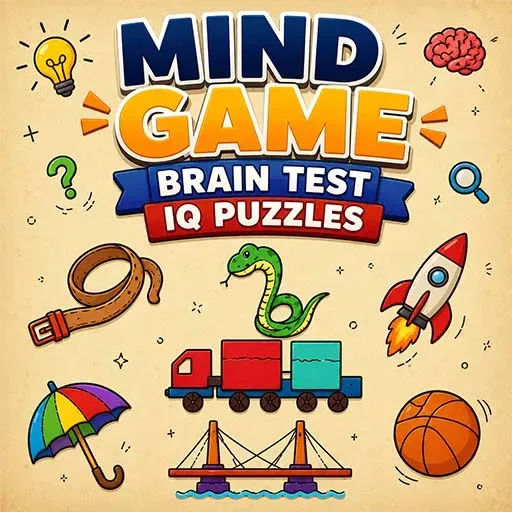
Standard puzzles have a clear method. The rules are stated. Following them produces the solution. IQ puzzle games deliberately mislead. Brain Test: Tricky Puzzles is built entirely on this premise. The game presents what appears to be a straightforward question; the player attempts the logical answer, and the game reveals that the correct solution requires ignoring the stated rules entirely. The phone needs to be tilted. The question is not asking what it appears to ask. The correct move is completely unexpected.
This lateral thinking format, finding the answer that the conventional approach misses, is closer to actual intelligence testing than any quiz format. It trains the brain to question its first interpretation of a problem before committing to a solution.
Do IQ puzzle games actually increase intelligence?
Research supports specific improvements in reasoning, processing speed, and spatial thinking from regular puzzle play. Dramatic IQ boosts from any single game are overstated. Consistent daily play of genuinely challenging puzzles for 15 to 30 minutes yields measurable cognitive benefits over time.
Free IQ Puzzle Games on Khelogy
All free. No payment. Open Khelogy, pick an IQ game, and start.
- Tricky brain puzzle games — questions that mislead, lateral thinking required, nothing is what it seems
- Logic IQ games — pattern sequences, spatial reasoning, deductive thinking, tested step by step
- Math and number IQ games — arithmetic logic, number patterns, problem-solving under pressure
- Visual IQ games — spot the difference, odd one out, pattern completion, spatial awareness challenges
Logic Games Pattern First, Answer Second
The answer is hidden inside the pattern. Find the pattern, and the answer becomes obvious.
Logic IQ games present sequences of numbers, shapes, colors, and objects with one element missing. The player has to identify the rule governing the sequence before they can supply the missing piece. The rule is never stated. The player has to derive it from the examples given. Getting it right means building the correct model of the pattern in working memory and applying it to a new case.
Sudoku operates on exactly this principle. The rules are simple: nine numbers, each appears once per row, column, and grid section. Nothing complex. But completing a hard Sudoku grid requires holding dozens of constraints simultaneously in working memory while testing possibilities against all of them. Research consistently ranks Sudoku among the traditional puzzles with the strongest evidence for improving working memory and logical reasoning.
Tricky IQ Tests Think Differently
What seems to be the question is not the question.
Brain test games designed around IQ challenges deliberately break the player's assumptions. A question might ask which number comes next in a sequence, and the correct answer involves something visible on screen that has nothing to do with the sequence. The question might ask for the largest number, and the correct answer is tapping on a physically larger font rather than a numerically larger value.
These games train a specific and genuinely useful skill: not committing to an interpretation of a problem before examining it from multiple angles. That hesitation before the first answer is not doubt, it is intelligence.
Are IQ puzzle games good for kids?
Age-appropriate versions work well. Simple pattern games, odd-one-out challenges, and basic logic sequences suit children from around age five. Genuinely tricky lateral thinking games are more appropriate from age eight or nine, when the cognitive flexibility to question first interpretations has developed enough to make the format engaging rather than frustrating.
No Download. Opens in the Browser.
The browser opens. The first puzzle appears. Think before clicking.
No app. No installer. Works on Chrome, Firefox, and Safari. Phone, tablet, and desktop all handle IQ puzzle games without issues — the games are lightweight by design, focused on logic rather than graphics.
Why Khelogy?
- No account. No download. Nothing between you and the first puzzle.
- Open Khelogy. Pick an IQ game. The answer is in there somewhere.
- Over 1,000 free games. Loads in any browser. Works on phone, tablet, and desktop. New games are added regularly.