
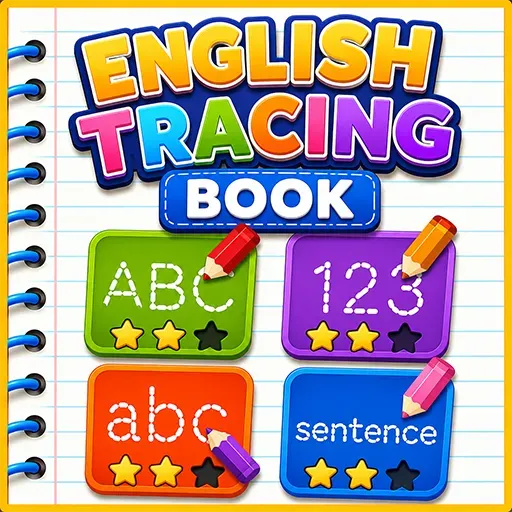
About Tracing Learning Games
Tracing games are not just screen time. Every path a child follows builds the same hand control that writing, drawing, and cutting all depend on. The dotted line is doing real work — and the child thinks they are just playing.
Khelogy has free tracing games covering alphabets, numbers, shapes, and basic lines. Each format targets a different stage of development, from wide simple paths for toddlers to full letter and number tracing for children approaching school age. No download. No account. The first dotted line is already on screen.
What Tracing Actually Builds?
Fine motor control first. Everything else follows from that.
Holding a stylus or finger steady along a dotted path requires the small muscles in the hand and fingers to work precisely together. That coordination built through repeated tracing is the same control needed for handwriting, drawing, and using scissors. Children who struggle to stay within lines are showing a sign that fine motor development needs more practice, not harder worksheets.
Brain imaging research from a Norwegian university found that when children write by hand, brain areas involved in motor and visual processing sync up with areas crucial to memory formation at frequencies linked to learning. That synchronized brain activity does not appear during typing. Tracing is not busywork. It is the brain forming pathways that reading and writing later depend on.
Alphabet Tracing Games
A before B. Uppercase before lowercase. One stroke at a time.
Alphabet tracing games show dotted letter paths with a marked starting point. The child follows the path — sound effects confirm correct traces, animations reward completion. Each successful trace reinforces three things at once: the shape of the letter, the sound it makes, and the muscle movement required to form it.
Uppercase letters come first. They use mostly straight lines, L, T, I, E, which suit younger hands better. Lowercase arrives later with more curves and more precision required. Letters like a, d, g, and q all use curved strokes that take real control.
Are tracing games good for preschoolers?
Very good. Simple shape and line tracing suit ages two to three. Full alphabet tracing fits ages four to five better when fine motor control has developed enough for the precision it needs.
Free Tracing Games on Khelogy
All free. No payment. Open Khelogy, pick a tracing game, and start.
- Alphabet tracing games — dotted letter paths, audio feedback, uppercase and lowercase options
- Number tracing games — trace 0 through 9, counting reinforced alongside number shape learning
- Shape tracing games — circles, squares, triangles — foundational strokes before letters begin
- Line tracing games — straight lines, curves, zigzag paths — the very first step before letters and numbers
Number Tracing Games
Recognizing a number is different from writing it correctly.
A child can spot the numeral 5 on a page long before they can form it correctly. The shape is counterintuitive — a vertical line, a curve back, then a flat cap added last. Without tracing practice, many children write it backwards or start from the wrong point. Number tracing games show the correct starting position and stroke direction explicitly, which paper worksheets can only do if a teacher watches every child individually.
Good number tracing games pair the numeral with visual counts — five stars, five animals, five objects — so the abstract symbol connects to a real quantity. Both pieces of knowledge are built at the same time.
What is the right starting age for number tracing games?
Most children handle simple number tracing from around age three or four. Start with single digits on large paths and move to smaller, more precise formats as control improves.
Shape Tracing Before Letters Come Shapes
The letter O is a circle. The letter L is two straight lines. The letter S is two opposing curves.
Children who have already traced basic shapes carry the muscle memory for the strokes that letters are built from. Shape tracing is the most appropriate starting point for very young children, simpler than letters, immediately recognizable, and it builds the same foundational control. Keeping a steady circle closed at the right point is genuinely hard for a three-year-old's hand. That difficulty is the point.
No Download. Opens in the Browser.
The browser opens. The first letter appears. Follow the dotted path.
No app. No installer. Works on Chrome, Firefox, and Safari. Tablets and phones work especially well, with finger tracing on a touchscreen is closer to pencil on paper than mouse tracing on a desktop. The touch mechanic is more natural for young children than clicking.
Why Khelogy?
- No account. No download. Nothing between the child and the first dotted line.
- Open Khelogy. Pick a tracing game. Start at A.
- Over 1,000 free games. Loads in any browser. Works on phone, tablet, and desktop. New games are added regularly.
- Trace the letter. Again.